Sunday, May 22, 2005
Photos Of JPL Open House: Nukes Are Good.

A man and his nuke. This JPL employee is leaning on a Radioisotope Thermoelectric Generator. An RTG, as it's called, generates electricity from the heat created by the decay of its plutonium fuel. (Click here for facts about RTGs in space.) RTGs have been used safely and successfully in many robotic missions as well as in Apollo missions RTGs are not able to generate large amounts of electricity so NASA is developing a nuclear reactor for future space missions. Nuclear power is necessary if we are to make any progress in exploring the solar system. Missions to the outer reaches of the solar system cannot rely on solar power because the sun's light is too feeble in deep space. Human missions to the moon and beyond will also depend on nuclear power. Although current plans for a base on the moon assume solar power, we cannot realistically rely on solar power on the moon because of that pesky 14 day-long night. A nuclear power generator would provide a more stable power source during the long and cold lunar night. Human missions to Mars and beyond could be shortened tremendously with the use of nuclear propulsion, in place of the chemical rockets we rely on today. The other photos in today's set show examples of NASA's successful use of nuclear power in space and some of their plans for future uses.

Labels: JPL Open House 2005


This is a desk-top model of perhaps the most successful RTG powered spaceships to date, Voyagers 1 and 2. These ships were launched in 1977 and are still operating, thanks to their nuclear power plants. In their 28 years of flight the ships passed Jupiter, Saturn, Uranus and Neptune. The ships are presently approaching the outer limit of the Heliosphere. They are likely to become the first ships to enter interstellar space in the next 10-20 years. (Click here for details of their mission.) Their RTGs can power them until 2020 to 2025. Budgets might end their mission before then, however. Although they only require about $4 million per year to operate, the Voyagers' continued funding is in doubt.
Labels: JPL Open House 2005
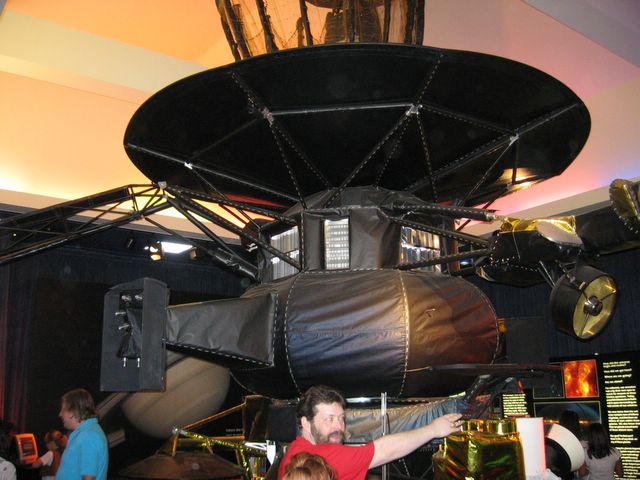
Another ship that used RTGs for power was the Galileo. (I have no idea why the full-size model on display at JPL was clad in black leather. It does look cool, though.) Galileo was was sent to explore Jupiter and its moons in 1989. It arrived at Jupiter in 1995. For the next 8 years it explored the gas planet and its moons. One of its discoveries was evidence of an ocean under the ice on Europa. Galileo's mission came to an end in 2003, when it was directed to fly into Jupiter, where it was crushed by the atmosphere. (Click here for more details of the mission.)
Labels: JPL Open House 2005
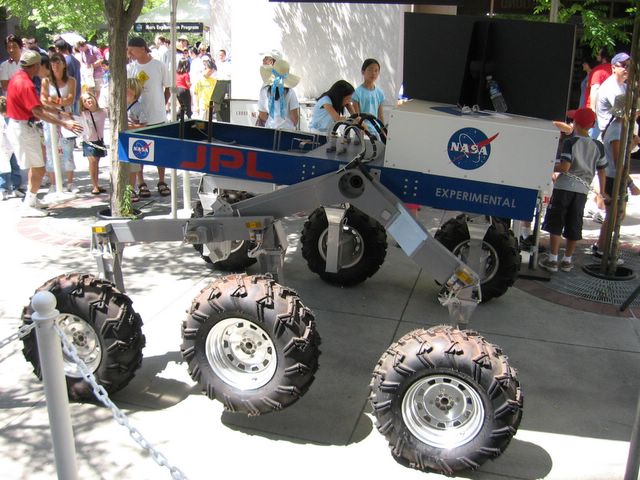
Full-size model of the Mars Science Laboratory rover scheduled for launch in 2009. This rover is often described as SUV-size. In reality, it is appears to be about the size of a car. The Mars Science Laboratory's mission will be to test the rocks and ground of Mars for signs of life. Its mission is designed to last for 2 years. The rover's size, instrumentation, and its mission duration require a power source more powerful than solar panels. The rover is expected to be powered by an RTG. When asked about the power source, a JPL employee explaining the Mars Science Laboratory at the open house was reluctant to discuss it. He first said on microphone to the crowd that solar power could be used, but when challenged about that he turned off the microphone and spoke privately, one to one, about the possibility of using nuclear power. (Click here for more details on the mission.)
Labels: JPL Open House 2005

Scale model of the Jupiter Icy Moons Orbiter, now scheduled for launch in 2017. JIMO, as it's called, is about 200 feet long. The panels in the center of the ship are not for solar power, they are heat radiators for the nuclear power plant located at the nose of the ship. The thrusters and science assembly are at the stern. JIMO's uranium-fueled nuclear power plant will create electricity through a nuclear reaction, much like conventional reactors on Earth. It will provide all power for the ship, including the electric-ion propulsion system. This differs from nuclear powered robotic missions to date, which have used RTGs for ship's power and standard chemical rockets for propulsion. The reactor is being developed by NASA in a program called Project Prometheus. (Click here for more details.)
Labels: JPL Open House 2005
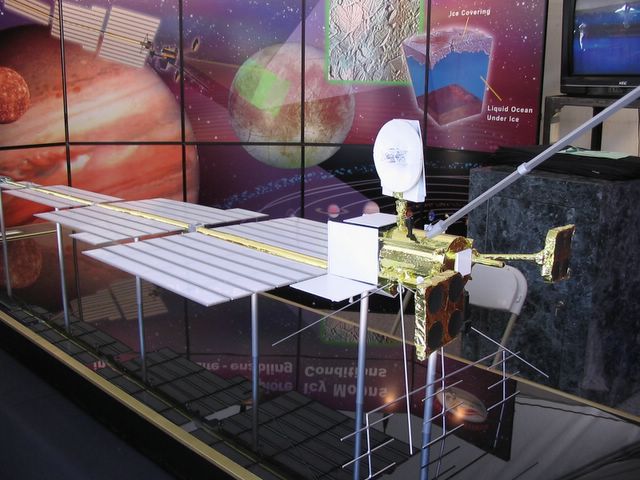
Rear view of JIMO showing close up of the thrusters and the science module. (Photo Credit, Gerry Williams, http://filmist.com.)
Labels: JPL Open House 2005
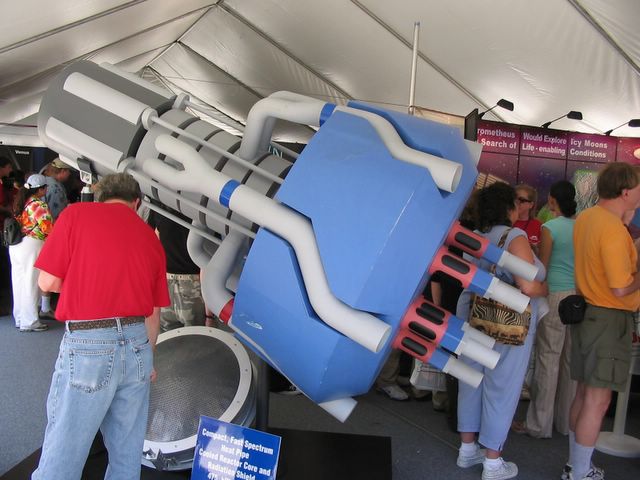
Full size model of the Project Prometheus reactor. (Photo Credit, Gerry Williams.)
Labels: JPL Open House 2005
Tuesday, May 17, 2005
Photos Of JPL Open House: Bots, Bots And More Bots.

This cool looking little rock climber is the Steep Terrain Access Robot or STAR. It's a concept robot for use in future missions on rough and steep terrain where less agile humans and robots cannot explore. Today's photo set is of robots of the future, robots about to be sent to Mars, and robots in use today.
Labels: JPL Open House 2005
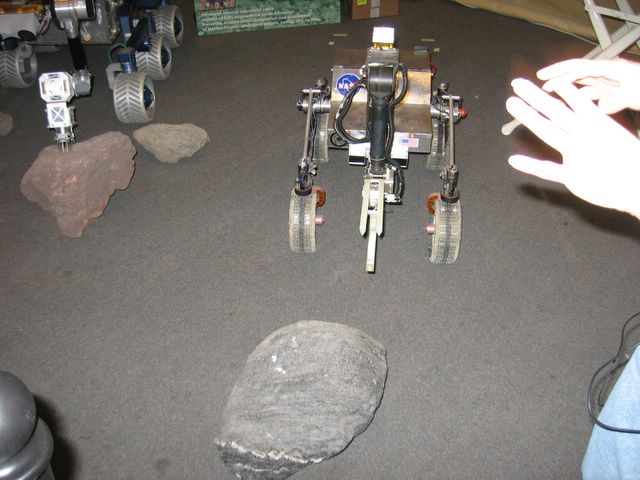
The little Sample Return Rover is pictured here. The rover is used to test an advanced control system. Currently, it can take up to 3 days and multiple commands for a robotic rover to approach and examine a rock. The SRR's system requires only one command. The rover is also able to move its legs and wheels to crouch down and stand up. This changes the rover's center of mass and will help it travel over rough terrain.
Labels: JPL Open House 2005

This is a 1/2 size model of the Mars Reconnaissance Orbiter, scheduled for launch this year. The orbiter will arrive at Mars in March of 2006 and for the next 8 months it will fly in and out of the upper reaches of the red planet's atmosphere 580 times to slow itself down to a circular orbit. This is a proven method for slowing down craft at Mars. The carbon dioxide atmosphere of Mars is 100 times thinner than Earth's nitrogen/oxygen air but the orbiter still must enter the atmosphere at a precise angle or risk burning up or flying past the planet.
Labels: JPL Open House 2005
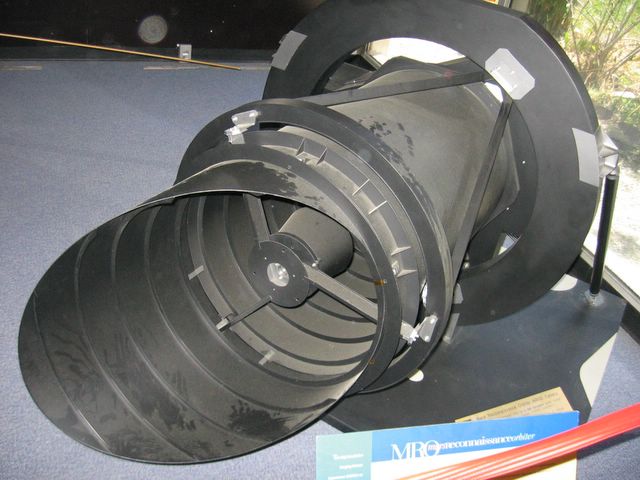
This is a full scale mockup of the camera which will be on the Mars Reconnaissance Orbiter. The camera will be able to resolve objects the size of a dinner table, a vast improvement over current cameras which can resolve school-bus size objects.
Labels: JPL Open House 2005

This is a full-size model of the Phoenix lander which will be sent to Mars to look for evidence of life. Scheduled to launch in 2007, it is the first of the so-called Mars Scout missions. Phoenix will land in the north polar region in May 2008 and operate until the winter, when the extreme cold will force its shutdown. The lander will have a robotic arm for digging up ground samples to a depth of 2 feet or so, below where the UV has sterilized the ground. The lander's instruments onboard will analyze the ground samples for evidence of organic molecules.
Labels: JPL Open House 2005
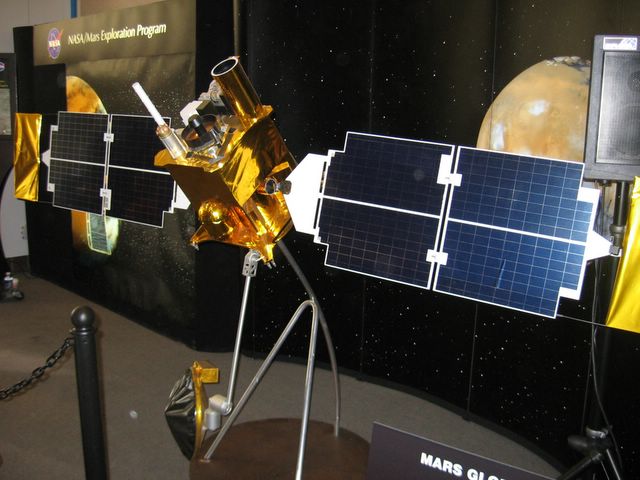
This is a 1/4 scale model of the Mars Global Surveyor. In orbit around Mars since 1997, the craft has completed 25,000 science orbits and taken over 187,000 images with its Mars Orbiter Camera, which is controlled right here in San Diego by Malin Space Science Systems. The mission's findings include determining that Mars has localized magnetic fields rather than a planet-wide field, weather and temperature mapping, and photographic evidence suggestive of recent water flow. Gullible true believers still think the so-called face on Mars is real but the Mars Orbital Camera proved it's a natural formation. Taxpayer money well spent.
Labels: JPL Open House 2005
Monday, May 16, 2005
Photos Of JPL Open House: Control Rooms And Factory Floors.
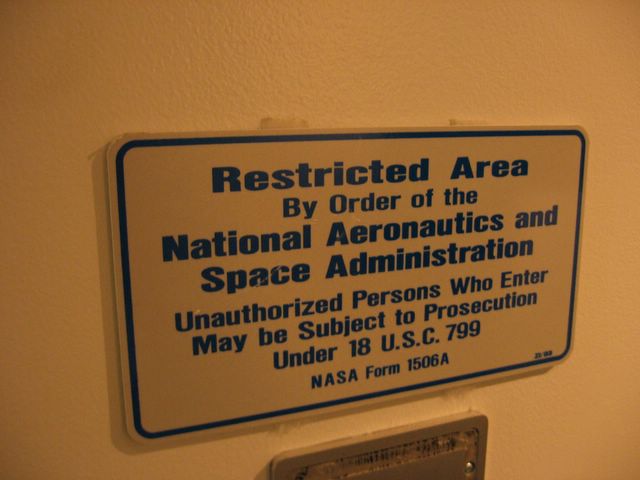
It's a crime to enter the control room of the Spaceflight Operations Facility of Jet Propulsion Laboratory without authorization. Fortunately for us it's not a crime to observe it and take photos. Check out the photos of the control room and other critical facilities at JPL taken during the open house on May 15, 2005.
Labels: JPL Open House 2005
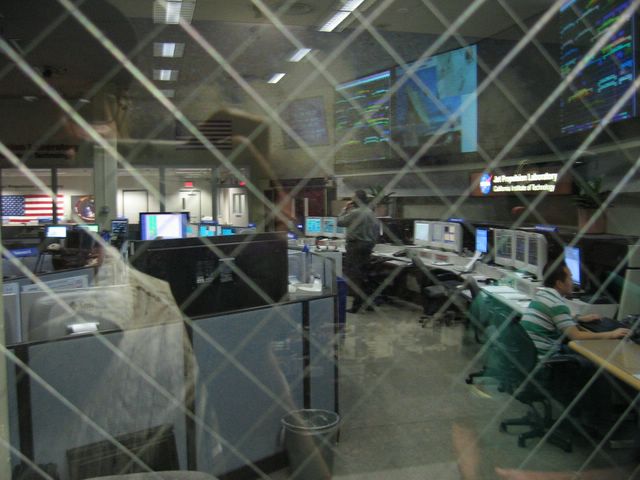
A view from the hallway into the Spaceflight Operations Facility. Several employees were on duty during the open house but there was not much activity apparent. The wallscreen at the far end of the room showed the flight information for both Mars rovers.
Labels: JPL Open House 2005
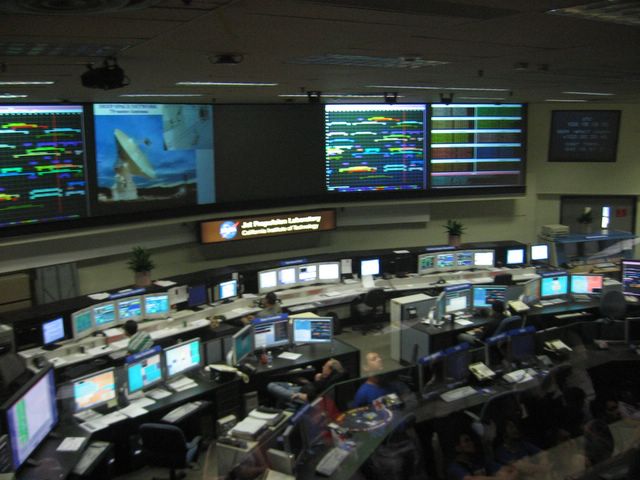
A view from the balcony of JPL's Spaceflight Operations Facility. This is the room where JPL controls the spacecraft in flight. The facility can control 36 craft per year and is staffed 24/7. The facility is connected to the Deep Space Network which has large antenna in North America, Australia, and Europe. JPL takes the data from this array and is able to navigate spacecraft on their missions. The DSN is also able to characterize the surfaces of other planets to find landing spots and to detect what objects in space are made of through radiometrics. The dark wallscreen on the far right showed the flight information for the Deep Impact probe, which is on its way to rendezvous with a comet later this year. The screen third from the right showed flight information for all current missions.
Labels: JPL Open House 2005
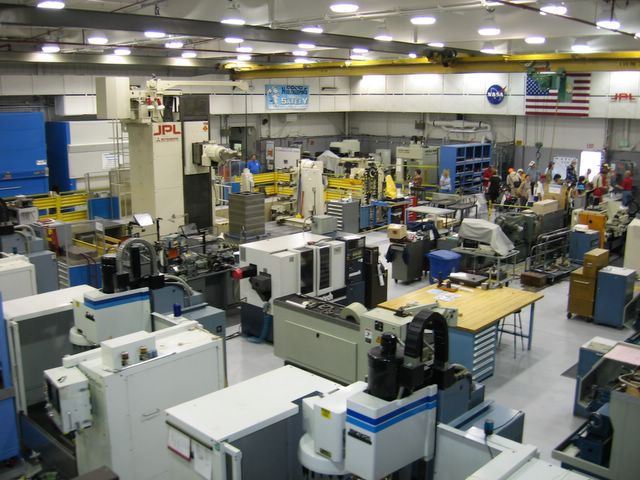
View from the catwalk of the Spacecraft Fabrication Building at JPL. This is where the machinists build the parts that go into the spacecraft.
Labels: JPL Open House 2005
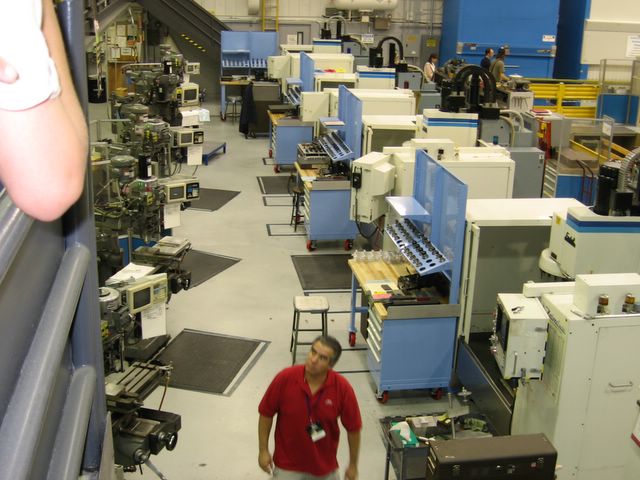
A JPL employee walks along a row of machinist's work stations in the Spacecraft Fabrication Building.
Labels: JPL Open House 2005
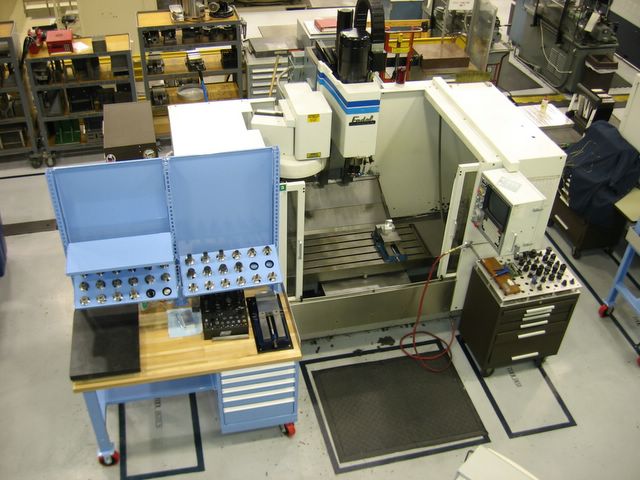
This is a typical machinist's work station in the Spacecraft Fabrication Buildling.
Labels: JPL Open House 2005

Second-floor view of the Spacecraft Assembly Room at JPL. The room is a very large clean room where spacecraft are prepared for their missions. The ceiling is about 3 to 4 stories high. The rectangles in the floor appeared to be vents. Unfortunately, JPL was not assembling any spacecraft during the open house so the room was empty. The size of the room was impressive enough by itself.
Labels: JPL Open House 2005

